Office & commercial glass

Meeting rooms that keep the light, not the noise.

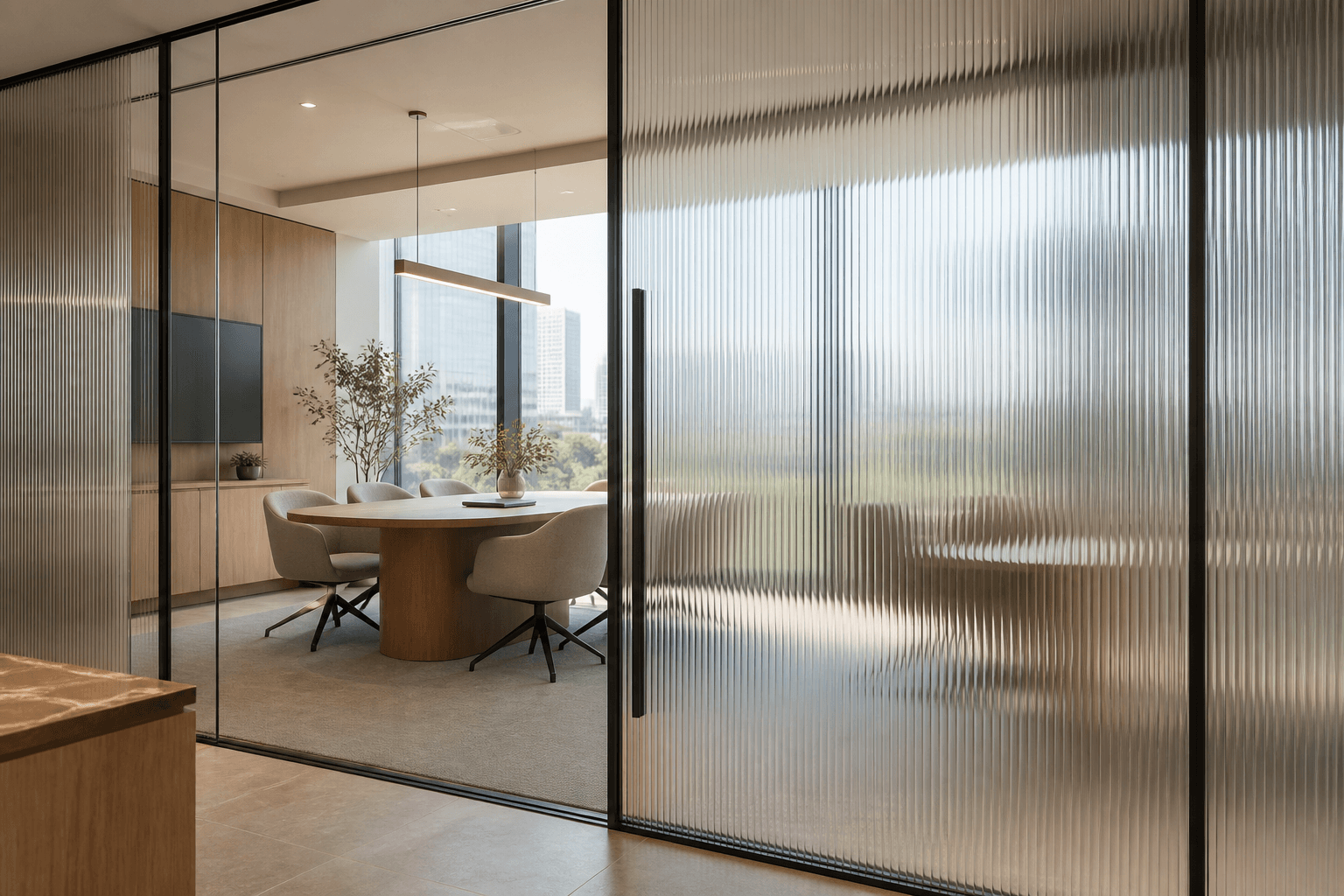
Glass partitions, glass doors and shopfronts for offices and shops.

Drawings first, then a site visit · ORE-approved installers · ORE responsible from start to finish

Placeholder image
  • Framed, frameless & double-glazed
  • Smart Glass privacy
  • NSI laminated safety glass
  • Supply only, or supplied & installed

Common problems

What goes wrong with office glass.

  • Meetings you can hear from outside

    A single thin pane lets conversations through. For a boardroom, finance room or HR room that is the one thing that must not happen.

    Answered in Systems
  • Glass that wobbles when the door moves

    Glass that is too thin for its height flexes every time the door swings, and the hinge points take the stress.

    Answered in Glass
  • Worrying about the glass breaking

    Ordinary tempered glass breaks into pieces that fall. In a busy office people walk past it all day.

    Answered in Laminated glass
  • A site that fights the installation

    Plasterboard ceilings that cannot hold a track, walls that are not square, panels too long for the lift, acidic sealant that yellows the glass edge.

    Answered in What installers check

Start with the room

What is the room for?

The room decides the need, the need decides the system, and the system decides the glass and the hardware.

  • BoardroomDouble-glazed partitionLaminated glassSealed door frameConfidential conversations stay inside
  • Meeting roomFrameless U-channel12mm temperedOpen and bright, used all day
  • Manager's officeSmart GlassFramed partitionSee the floor, or close the view at a switch
  • Finance & HRLaminated safety glassBottom patch lockNeutral, anti-mould sealantPrivate talks and a secure door
  • ShopfrontFramed or frameless glassFloor-spring doorDoor hardwareA strong entrance used all day

Privacy at a switch? See Smart Glass

Systems

Three ways to build it.

  • Frameless

    U-channel

    The track is hidden in the ceiling and floor, so you see only glass.

    Best for open offices and meeting rooms
  • Framed

    Aluminium frame

    Glass held in an aluminium frame with rubber seals — the sturdiest choice for doors used all day.

    Best for busy meeting rooms and entrances
  • Double-glazed

    Acoustic partition

    Two layers of glass with an air gap between them, and room for blinds inside.

    Best for boardrooms, finance and HR rooms
Placeholder image

Glass

The height decides the thickness.

Glass that is too thin for its height flexes. We choose it for your ceiling, not for the price.

Typical glass by height
  • Up to 2.4 m: 10mm tempered glass
  • 2.4 – 3.2 m: 12mm tempered glass, so it does not flex
  • Acoustic or safety: Laminated glass: 5mm + 5mm with an NSI interlayer
  • Taller than 3.2 m: Specified for the site after we see it
Placeholder image

Laminated glass

If it breaks, it stays in place.

Laminated glass holds the broken pieces on its interlayer instead of letting them fall.

Why ORE uses an NSI interlayer
  • Holds the pieces and still carries load after breaking
  • Stays bonded and clear at exposed, frameless edges
  • Compatible with neutral-cure silicone
  • Sound: STC 39 dB for 5 / 0.8 / 5mm, from the maker's test
  • Certified laminated safety glass (the maker's SGCC certification)

Doors & hardware

The door is matched to its weight.

We work out the weight of each door first, then choose hardware rated for it.

  • Floor spring

    Swing doors

    BPG-84 floor springs for doors up to 300 kg or 400 kg, tested to 500,000 cycles.

    For entrances and shopfronts
  • Hinges

    Hinged glass doors

    SUS 304 glass hinges rated 40 kg per pair — a heavier door gets a third hinge.

    For lighter room doors
  • Sliding

    Sliding doors

    Soft-close sliding systems for 8–10mm glass, where a door has no room to swing.

    For tight corridors

On site

What ORE-approved installers check.

Most glass problems start on site, not in the factory.

  1. Fixed to the concrete, not the plasterboard

    The top track goes through to the concrete slab, or onto a steel support above the ceiling.

  2. A gap above the glass

    The glass never presses the top of the track, so a ceiling that moves does not crack it.

  3. Both diagonals measured

    Openings are rarely square. Measuring corner to corner catches it before glass is made.

  4. Rubber blocks under the glass

    The glass sits on rubber setting blocks, never on metal or bare concrete.

  5. Neutral sealant only

    Acidic sealant attacks aluminium and yellows glass edges. ORE installs with neutral-cure silicone.

  6. A floor stop for every door

    A handle that hits the wall or the next panel is how glass doors break. Doors get a gap and a rubber floor stop.

For designers and contractors

The plain facts.

Systems
Frameless U-channel · framed aluminium · double-glazed acoustic
Tempered glass
10mm up to 2.4 m · 12mm for 2.4–3.2 m
Laminated glass
5mm + 5mm, NSI interlayer — holds the pieces if it breaks
Sound (maker's test)
NSI 5 / 0.8 / 5mm laminated glass: STC 39 dB
Floor springs
BPG-84 · doors up to 300 kg or 400 kg · 500,000-cycle tested
Glass hinges
BPG, SUS 304 · 40 kg per pair · a third hinge for heavier doors
Sliding doors
Soft-close systems for 8–10mm glass
Privacy
Smart Glass, clear on and frosted off
How it starts
Your floor plan or drawings, then a site visit
Payment
50% deposit to start
Supply only
Available for custom glass anywhere in Malaysia
We install in
KL · Putrajaya · Selangor · Penang · Negeri Sembilan · Melaka · Johor

How a project goes.

Five steps, and you always know which one you are on.

  1. Send the plan

    Floor plan or drawings first

  2. We visit and measure

    Ceiling, walls, floor, the lift

  3. Drawings & deposit

    Sizes fixed, 50% to start

  4. Glass is made

    Tempered glass cannot be cut later

  5. Installed & sealed

    24–48 hours before full use

Office and shopfront projects: see our Instagram

Send us the floor plan.

Mark the rooms you want in glass. We come back with the system, the glass and the doors we would use, then arrange the site visit.

WhatsApp us
Placeholder image

Before you ask

Questions offices ask first.

Ask ORE

Should my meeting room be frameless or framed?

Frameless U-channel looks cleanest and lets in the most light. For a confidential room, a finance room or a door used all day, a framed system with rubber seals is sturdier and quieter.

How soundproof can a glass partition be?

It depends on the system. A double-glazed partition with laminated glass and a sealed door frame is the quietest. ORE quotes sound figures only from the glass maker's own test reports — for example, NSI 5 / 0.8 / 5mm laminated glass tested at STC 39 dB.

Why not use 6mm or 8mm glass for a full-height partition?

Thin glass flexes above about 2.4 m, which feels unsafe and stresses the hinge points. Full-height partitions start at 10mm, and 12mm above 2.4 m.

Tempered or laminated — what is the difference?

Tempered glass breaks into small pieces that fall. Laminated glass holds the broken pieces on its interlayer. ORE's laminated glass uses an NSI interlayer that stays clear and bonded at exposed edges.

Can I have privacy only when I need it?

Yes — with Smart Glass, which is clear when switched on and frosted when switched off.

The glass is slightly too big. Can it be trimmed on site?

No. Tempered glass cannot be cut, drilled or ground after it is made — it shatters. Every size and hole is made in the factory, which is why ORE measures on site before anything is ordered.

Our ceiling is plasterboard. Can the track be fixed to it?

No. Plasterboard cannot carry glass. The top track is fixed through to the concrete slab, or a steel support is added above the ceiling.

The glass will not fit in our lift. What happens?

We check the lift and the route before ordering. If a panel will not fit, it is split into smaller panels or brought up another way.

How soon can we use the partition?

The sealant needs 24–48 hours to reach full strength. During that time, don't push the doors hard or blow strong air-conditioning onto the new glass.

Where is the safest place for a glass door lock?

At the bottom: a bottom patch lock goes into the floor, so no large hole is cut in the middle of the glass.

Do you need drawings first?

Yes. Send the floor plan or drawings, then we visit the site. Shopping malls may only allow work at night, and buildings with a management office need their approval — ORE provides the documents they ask for.

Can you supply the glass only?

Yes. ORE supplies custom glass anywhere in Malaysia, and supplies and installs in Kuala Lumpur, Putrajaya, Selangor, Penang, Negeri Sembilan, Melaka and Johor.